Lehekülg: 1
STUTTGART
:
 Luule 2008-06-18 (9723 hits
) Luule 2008-06-18 (9723 hits
)
FÊTE DE LA PAIX
:
Luule 2008-06-16 (12468 hits
)
Cântecul de ursită al lui Hyperion
:
 Luule 2009-06-23 (15714 hits
) Luule 2009-06-23 (15714 hits
)
Chant du destin d’Hypérion
:
Luule 2008-08-07 (16880 hits
)
Courage de poète
:
Luule 2008-06-18 (14374 hits
)
EMPEDOCLE
:
Luule 2008-08-02 (10243 hits
)
GERMANIE
:
Luule 2008-06-16 (10037 hits
)
Heidelberg
:
Luule 2008-06-18 (15981 hits
)
La Grèce
:
Luule 2008-08-05 (9683 hits
)
La vue
:
Luule 2008-08-05 (9478 hits
)
Le Neckar
:
Luule 2008-08-07 (10766 hits
)
Le pays
:
Luule 2008-08-06 (10581 hits
)
LE RHIN
:
Luule 2008-06-16 (20255 hits
)
L’acclamation des hommes
:
Luule 2008-06-16 (9292 hits
)
L’amitié
:
Luule 2008-08-02 (13880 hits
)
MÉTIER DU POÈTE
:
Luule 2008-06-16 (11777 hits
)
MOITIÉ DE LA VIE
:
Luule 2008-08-05 (10874 hits
)
PAIN ET VIN
:
Luule 2008-06-16 (26075 hits
)
PATMOS
:
Luule 2008-06-16 (25976 hits
)
RETOUR AU PAYS
:
Luule 2008-08-05 (14043 hits
)
SOUVENIR
:
Luule 2008-06-16 (17623 hits
)
Vie supérieure
:
Luule 2008-08-05 (9478 hits
)
Lehekülg: 1 |
|

|
|
|
|
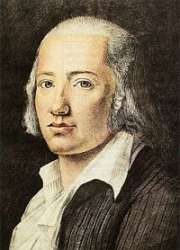
Biograafia HÖLDERLIN, Friedrich
Johann Christian Friedrich Hölderlin (20 March 1770 – 6 June 1843) was a major German lyric poet. His work bridges the Classical and Romantic schools.
Having spent most of his life tormented by mental illness, he suffered great loneliness, and often spent his time playing the piano, drawing, reading, writing, and enjoyed travelling when he had the chance.
The poetry of Hölderlin, widely recognized today as one of the highest points of German literature, was little known or understood during his lifetime and slipped into obscurity shortly after his death; his illness and reclusion made him fade from his contemporaries' consciousness – and, even though selections of his work were being published by his friends already during his lifetime, it was largely ignored for the rest of the 19th century.
In fact, Hölderlin was a man of his time, an early supporter of the French Revolution – in his youth at the Seminary of Tübingen, he and some colleagues from a "republican club" planted a "Tree of Freedom" in the market square, prompting the Grand-Duke himself to admonish the students at the seminary. He was at first carried away by Napoleon, whom he honors in one of his couplets (it should be noted that his exact contemporary Beethoven also initially dedicated his Eroica to the Corsican general).
Like Goethe and Schiller, his older contemporaries, Hölderlin was a fervent admirer of ancient Greek culture, but had a very personal understanding of it. Much later, Friedrich Nietzsche would recognize in him the poet who first acknowledged the Orphic and Dionysian Greece of the mysteries, which he would fuse with the Pietism of his native Swabia in a highly original religious experience. For Hölderlin, the Greek gods were not the plaster figures of conventional classicism, but living, actual presences, wonderfully life-giving and, at the same time, terrifying. He understood and sympathized with the Greek idea of the tragic fall, which he expressed movingly in the last stanza of his "Hyperions Schicksalslied" ("Hyperion's Song of Destiny").
2004 film, The Ister, is based on Martin Heidegger's 1942 lecture course (published as Hölderlin's Hymn "The Ister"). The film features Jean-Luc Nancy, Philippe Lacoue-Labarthe, Bernard Stiegler, and Hans-Jürgen Syberberg.
The 1985 film Half of life is named after a poem of Hölderlin and deals with the secret relationship between Hölderlin and Susette Gontard. It stars German actors Ulrich Mühe and Jenny Gröllmann.
In 1986 and 1988 Danièle Huillet and Jean-Marie Straub shot two films "Der Tod Des Empedokles" and "Swarze Sunde" in Sicily, which were both based on the ominous Holderlin drama (respectively for the two films they used the first and third version of the text).
A 1981-82 television drama, "Untertänigst Scardanelli" (The Loyal Scardanelli), directed by Jonatan Briel in Berlin.
|





 Soovitame Lugeda